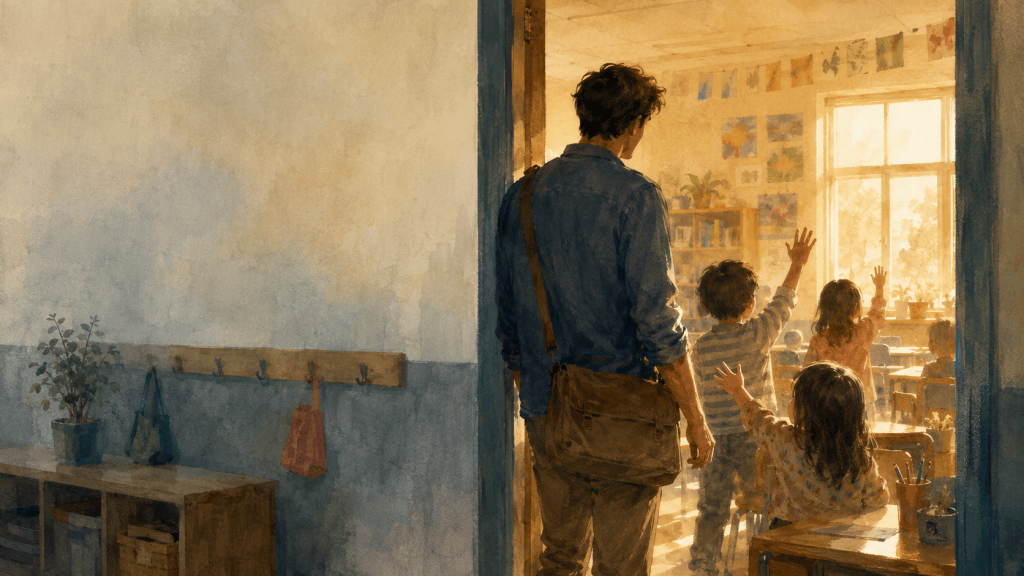
This is the week I have anticipated for months.
My last Monday at Maple Bear.
My last Tuesday.
My last Wednesday.
My last Thursday.
And, finally, my last Friday.
I imagined this week mostly as a countdown to freedom—each “last” another door unlocking, another day survived, another step away from a place that has consumed far too much of me.
There is relief. Enormous relief.
But now that the week is here, there is sadness too.
This goodbye was always inevitable. My contract would have ended in February, and I would have said goodbye to my students then. But I chose to bring that ending forward. I chose to leave after six months, only halfway through my contract, because another six months in this environment was too high a price to pay.
Leaving early does not mean leaving lightly.
Korea has been difficult for me in ways that extend beyond one workplace. There has been loneliness, isolation, and culture shock. I have struggled with the food and found too little enjoyment in my life outside school. Without enough happiness, connection, or restoration waiting for me at the end of the day, the drama at school followed me home. It seeped into evenings and weekends that should have belonged to me.
Many of the most difficult parts of my school experience came from the adults. Without the dysfunctional relationships, unreasonable expectations, and constant conflict, this might have been a good experience—at least within the classroom.
Because the children were never the problem.
One of the hardest things has been watching children get scolded because they did not learn something the first time or could not remember it forever. I have watched six-year-olds face expectations that would be unreasonable even for many adults: learn immediately, remember permanently, correct your behavior at once, and never need another reminder.
But six-year-olds are not small adults.
They are children.
They need repetition and patience. They need the freedom to make mistakes without believing that a mistake makes them bad. They need time to move, imagine, laugh, forget, and try again.
I have also seen how much stress Korean children can carry. Many attend school all day, then go somewhere else to learn English, and then continue to another academy for still more lessons. Their weekdays are long, and their weekends may be filled with study too.
I have often wondered when they are allowed simply to be children.
When do they play without a learning objective? When do they explore something only because it interests them? When do they rest without falling behind? When do they get to experience childhood as something other than preparation for the next examination, the next school, and the next expectation?
It has been heartbreaking to watch children lose time that should belong to them: time to play, to be silly, to discover who they are, and to enjoy the freedoms of childhood.
And yet, despite everything asked of them, they still arrive carrying so much love.
It appears in an unexpected hug.
It is a small hand reaching for mine as we walk down the hall.
It is a child bursting with excitement because there is a story to tell me about the weekend.
It is a request for a high five.
Sometimes it is a child putting a death grip on my hand and refusing to let go. Sometimes it is being dragged across the room or down the hall because there is something urgently important that I must see.
It is hearing, “I love you.”
It is hearing the six students in my Edmonton class say in unison, “Good morning, Phillip Teacher.”
Those are the moments I will carry with me.
I do not need to pretend that the painful parts did not happen or turn a difficult experience into a sentimental success story. Leaving early was the right decision. But the failures of the adults do not belong to the children, and I will not allow those failures to define what my students meant to me.
I taught learners ages five to thirteen, and every one of my students was good. Every one of them was worthy of patience, dignity, safety, and love. They were funny, curious, affectionate, mischievous, complicated, and entirely themselves.
They gave me their trust. They invited me into their stories and their small daily discoveries. They held my hand. They made me laugh. They reminded me, even during the most difficult days, why teaching can matter so deeply.
A year from now, I do not think the dysfunctional adult relationships will be what I remember most.
I will remember the hugs.
The stories.
The high fives.
The hands reaching for mine.
The chorus of “Good morning, Phillip Teacher.”
I will remember the love my students gave me—and the love I was fortunate enough to give them in return.
This week, I will say goodbye to Monday, Tuesday, Wednesday, Thursday, and Friday at Maple Bear. I will gladly leave behind the conflict, the loneliness, and the unreasonable expectations.
But I will miss my students very dearly.
All of them.
They have each become special to me. The memories we made belong to us, and no difficult adult relationship can take them away.
This is my week of lasts.
It is an ending I chose sooner than expected because I needed to leave.
And it is a goodbye that was always going to hurt.
 Phillip N. Patrick
Leave a comment